In brief:
- If someone you’re travelling with experiences in-flight anxiety you can help them to stay calm, reducing the risk their anxiety will spiral into a panic attack
- By being present, you can help the person to stay grounded – reducing the risk they get lost in their own thoughts
- You can learn some effective breathing and grounding exercises that can help them to relax – these are all available in the free Calm Flight Toolkit
Supporting someone else with flight anxiety
Travelling with someone who panics? This can be a trigger to you, even if you’ve never panicked in the air before.
If a family member, friend, or flying companion is showing signs of anxiety or looks like they’re about to experience a panic attack, here are a few things you can do to help them (and help yourself, too, if you’re an anxious flyer).

Stay calm
Staying calm is the number one thing that you can do to support someone with flight anxiety.
Your energy and response set the tone. It’s a process known as co-regulation. The dynamic is seen most clearly in the parent-child dynamic, but it also works between partners, family members and friends. You can also provide reassurance to someone you’ve never met before.
By staying calm, you’re demonstrating that the situation isn’t stressful.
Talk reassuringly
People with inflight anxiety can often find they disappear into their own thoughts. This can be dangerous, setting off a spiral of negative thoughts that can worsen. You can help to break them out of this by talking.
You can talk about anything and everything. Talking can help the person break free of negative thought patterns. Chatting about what you’ll do later or what you’ll see and experience when you land can be powerful at grounding the person.
During times of increased stress (like takeoff or during turbulence, for example), you may want to offer some reassuring words.
Breathe slowly
Show them how slowing breathing can help. By modelling regulation you can increase their relaxation.
You can model this behaviour, or, if you want to go further, use breathing exercises and techniques that can help.
Diaphragmatic breathing (breathing in for count of 4, holding for 4 and exhaling for 8), for example, can be highly effective.
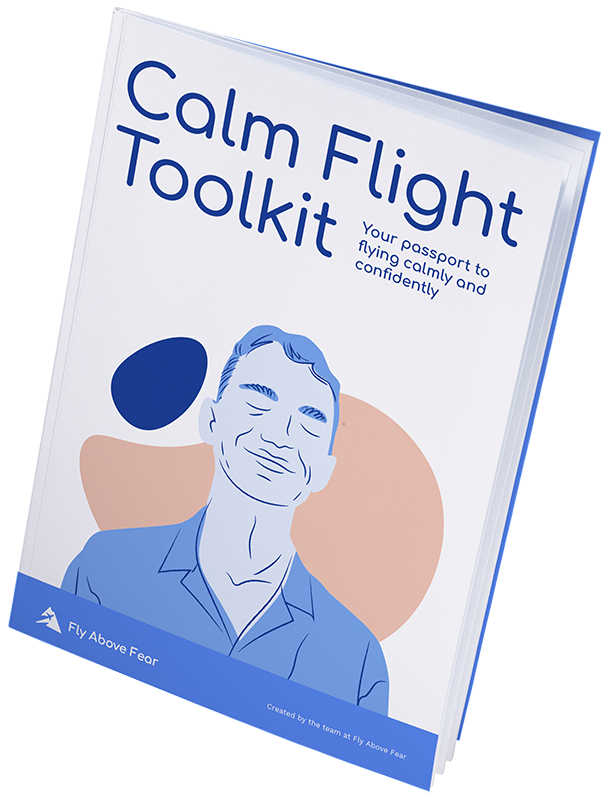
You can check out a selection of breathing exercises here, or download the Calm Flight Toolkit.
Ask how they’d like to be supported
It’s important that you ask how someone might want your support. Sometimes, just knowing someone is there can be enough at reducing anxiety.
They may want to speak with you, or they may wish to be left alone. It’s vital that you empower them, making them feel comfortable and in control, even if that means you taking a step back.
Why [reparation is key
If you’re flying with a person that afraid of flying, you can – and should – prepare in advance by learning some simple tools and techniques that can help them.
Read our guides on breathing exercises, mindfulness and grounding. There you’ll find multiple strategies that you can use to support an anxious flyer.
We’ve also prepared our Calm Flight Toolkit which contains a huge amount of information in a simple and easily accessible format.
If you’re interested in learning more about the causes of flight anxiety and other evidence-based ways to reduce fear of flying, visit the Help Desk.
FAQs
Can I help someone if they’re about to go into a panic attack on a plane?
Yes. You can help to prevent their anxiety from spiralling into a panic attack by staying calm. This helps to demonstrate that the situation isn’t stressful. It also initiates a process known as co-regulation. You can also talk reassuringly to break their negative thought patterns, and ask how they’d like to be supported. Sometimes just knowing you are there is enough.
Can breathing help someone with in-flight anxiety?
Modelling slow breathing can help increase their relaxation by demonstrating regulation. Diaphragmatic breathing can be a highly effective technique. You can also check out a selection of breathing exercises on the Help Desk, or download the Calm Flight Toolkit.
How can I help a fearful flyer if I’m afraid of flying?
By focusing on staying calm, talking reassuringly, and modelling slow breathing, you help your travel companion while also helping yourself. Preparation is key, and you should learn simple tools and techniques like breathing exercises, mindfulness, and grounding in advance – all of which you can find on the Help Desk.