In brief
- Turbulence is caused when an aircraft moves through layers of air moving at different speeds or directions
- There are four types of turbulence (clear-air turbulence, mechanical turbulence, thermal turbulence, wake turbulence)
- Planes are designed to safely fly through all forms of turbulence
- Calming techniques can help you cope with the experience of turbulence
Describing the causes of turbulence
Turbulence in an aircraft is caused by the aircraft flying through dynamic weather. Turbulence is a normal, expected, and perfectly safe part of flight. In fact, the more you understand about it, the less you’ll worry.
We know it’s hard, especially when the media misrepresents the risk of turbulence so often. You need to feel the bumps, not fear them – and we can show you how.
In this article we explore what turbulence is, what causes it, and why pilots and engineers find turbulence annoying, but not a cause of anxiety.
What is turbulence, really?
At its most basic, turbulence is just chaotic air movement. When an aircraft moves through layers of air moving at different speeds or directions, it encounters friction. That’s felt as a bump or a jolt inside the aircraft, what we call turbulence.
Imagine driving a boat through choppy water. The boat’s structure flexes, the passengers jostle, but everything continues as normal. It’s the same feeling as driving on a bumpy road in a car.
Most passengers are happy to travel in a car or a boat and experience bumps that are equally as severe without passing a thought. Why? It’s all about perspective.
You can’t see air movement, so your brain interprets turbulence as a threat. It feels random and uncontrollable and that’s scary (especially if you’re a person that likes to be in control).
Turbulence is a huge cause of anxiety for fearful flyers. The reality is that most flights will encounter some turbulence, but the majority will barely register inside the cabin.
Understanding what causes turbulence can help fearful flyers to gain a new perspective on those bumps.
Check out our video on what causes turbulence:
The four main causes of turbulence
Turbulence isn’t one thing, it’s a catch-all term that covers several distinct atmospheric processes.
The four causes of turbulence are:
- Clear-air turbulence
- Mechanical turbulence
- Thermal turbulence
- Wake turbulence
Let’s go through each of these in order and provide more detail on the cause of turbulence and how pilots work to avoid it.
Clear-air turbulence (CAT)
Clear-air turbulence usually occurs at high cruising altitudes, especially near or just above the tropopause. That’s the atmospheric boundary separating the troposphere (where weather happens) from the stratosphere (which is more stable).
CAT turbulence is most common around jet streams. These are narrow bands of fast-flowing air, often moving at over 150 mph. These streams slice through slower-moving air around them, creating shear zones.
Shear zones are specific areas where air speed or direction changes rapidly across a short distance and it’s in these shear zones that CAT most often occurs.
What makes CAT so challenging for pilots and weather predictors is that the air above, below or even at the sides might seem smooth, but high-speed winds are interacting in chaotic, often unpredictable ways.
CAT produces no moisture, so there are no clouds to act as visual cues and can’t be detected by on-board radar.
How pilots manage CAT
While weather radar can’t detect CAT directly, modern aircraft receive updates from other aircraft via PIREPs (Pilot Reports), ACARS, and dispatch alerts.
Crews can – and often will – adjust their altitude by just a few thousand feet to find smoother air. CAT isn’t dangerous, but it can be uncomfortable. If the seatbelt sign comes on even when the skies outside look perfectly clear, it’s likely to be CAT.
Mechanical turbulence
Mechanical turbulence happens closer to the ground and it’s caused by the wind.
As wind flows over mountains, buildings, ridges, or even forested areas, it’s disrupted. These physical obstructions force the air to rise, twist, and break into eddies that can cause turbulence.
Mechanical turbulence is stronger when wind speeds are high, or when strong low-level winds interact with surface features.
Mechanical turbulence is a particular problem during takeoff and landing, when aircraft are low, slow, and in a more vulnerable phase of flight.
How pilots manage it:
Mechanical turbulence is well mapped and well understood. ATC and flight planning systems account for local terrain-induced disturbances. Pilots are briefed on expected wind shear and turbulence based on both forecast data and actual observations from preceding flights.
Most mechanical turbulence can be predicted and avoided.
Thermal turbulence
Thermal turbulence (or convective turbulence) is caused by warm air rising from the ground.
As the sun heats the Earth’s surface, patches of warm air rise and cooler, denser air sinks to replace it. These opposing motions create vertical currents that are irregular and unstable, which can result in turbulence.
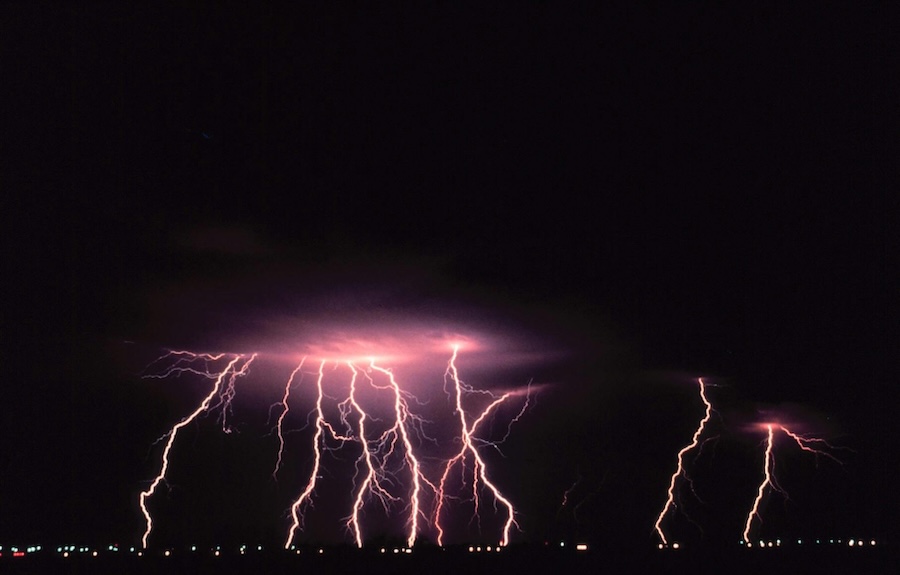
Thermal activity can also create thunderstorms, which produce strong updrafts and downdrafts. These can be hazardous to planes, but are easy to forecast and to spot though the air. Pilots will actively avoid flying near thunderstorms.
How pilots manage it:
Convective forecasts give pilots a heads-up for areas of potential thermal turbulence. Because of this, effective routing often avoids large convective zones altogether.
Pilots will also navigate around thunderstorms, not through them. When flying at night, you can sometimes see thunder crackle outside, but you’re entirely safe.
Wake turbulence
When a plane generates lift, it also generates wingtip vortices. There spirals of air trail behind the wings and can spell danger for planes that encounter them.
The bigger the aircraft, the stronger the vortex. These invisible whirlwinds can persist for miles behind an aircraft and are especially dangerous to smaller planes flying too close behind.
Wake turbulence is most critical during takeoff and landing, when aircraft are close together and moving at lower speeds. Air traffic controllers understand the dangers of wake turbulence and can space out flights to avoid it.
How pilots manage it:
Wake turbulence is a well-known, well-managed phenomenon.
ATC enforces mandatory spacing between aircraft, and pilots are trained to recognise and avoid wake zones. You’re unlikely to ever encounter wake turbulence as a commercial passenger because of the strong processes and procedures in place to manage it.
Feel the bumps, but don’t fear them
Turbulence is simply an unavoidable, but entirely safe, part of flying. Commercial planes are designed for turbulence and can cope with turbulence at levels no passenger or pilot is ever likely to experience in millions of hours of flying.
Behind the scenes, pilots, forecasters and air traffic control are actively working to reduce turbulence on every flight.
Next time the bumps begin, try to remember you’re flying through air that’s a little less smooth than usual. The feeling is uncomfortable but it’s temporary. In the end, it’s just weather doing what weather does.
If you need some help managing flight anxiety, visit the Help Desk and download the free Calm Flight Toolkit.
Please share this article with anyone who might benefit from it.
FAQs
Turbulence is caused when an aircraft flies through dynamic weather. The changes in weather can cause the plane to momentarily move up and down, and side to side. While iit may feel uncomfortable inside the cabin, turbulence is completely normal and safe part of flight.
There are several causes of turbulence, including clear-air turbulence,
mechanical turbulence, thermal turbulence, and wake turbulence. Pilots are aware of turbulence from forecasts and real-time data provided by PIREPs. Where possible, pilots and flight planners will attempt to avoid turbulence, ensuring your ride is as smooth as possible.
Turbulence forecasts available to the public are highly inaccurate and shouldn’t be relied on. The science simply doesn’t support the claims they make and there’s an argument that instead of reducing anxiety, turbulence forecasts amplify it.