In brief
- Turbulence is a safe and normal part of flight, but the anticipation of turbulence can trigger stress and anxiety
- Turbulence feels threatening because our brains perceive the feelings and sensations as dangerous, even though they’re not
- All forms of turbulence are well understood, carefully monitored, and actively managed by pilots, air traffic control, and flight planners
- Understanding what turbulence is, why it happens, and what to expect can help to provide some calm before and during your flight
Why turbulence can cause anxiety
Turbulence is a common fear for nervous flyers, with the lumps and bumps associated with it a source of anxiety. It’s not just the experience of flying through turbulence that can cause discomfort, the anticipation of turbulence can be a source of stress before, and during a flight.
Turbulence feels threatening because our brains perceive the feelings and sensations as dangerous. The reality is that turbulence is a safe and normal part of flight.
In this guide, we’re going to explore what turbulence actually is and why it’s not dangerous. We’ll then look at the causes of turbulence and why forecasting turbulence is a challenge. Finally, we’ll look at some of the practical things that you can do to reduce in-flight anxiety.
We’re not going to promise that we can cure your fear of flying, but by understanding what turbulence is – and why it’s a normal part of flight – can potentially help to provide some balance and calm before your flight.

What turbulence actually is
It’s important to understand what turbulence is, what causes it and why it’s just weather doing what it does. If you’re interested in learning more about turbulence read our in-depth guide on what causes turbulence.
Turbulence at its most basic level occurs when an aircraft flies through air moving at different speeds or directions.
These irregular air movements create the bumps passengers feel. Most turbulence feels a lot like driving a car over a rough road.
There are four main types or causes of turbulence:
- Clear-air turbulence (CAT) near jet streams at cruising altitude
- Mechanical turbulence caused by wind over terrain during takeoff and landing
- Thermal turbulence from rising warm air and thunderstorms
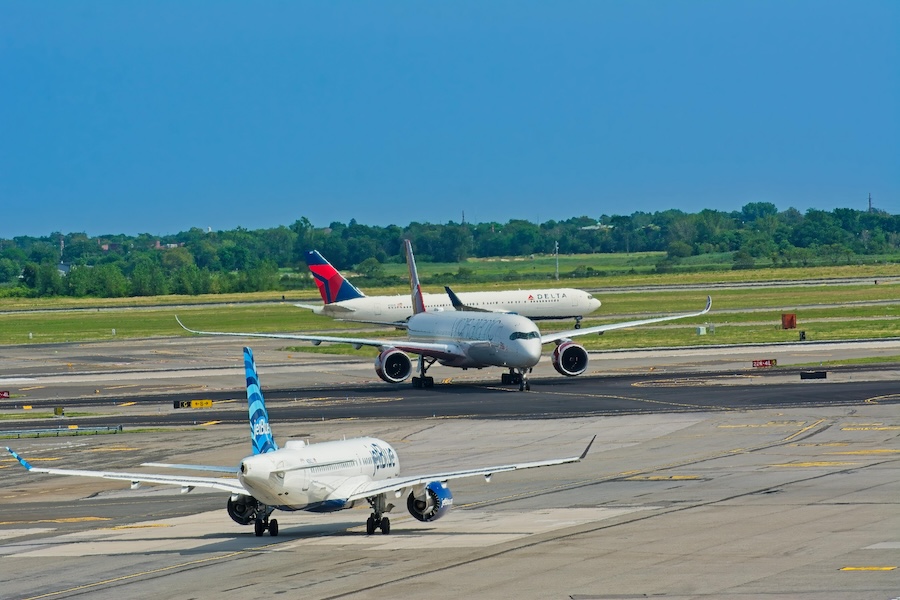
- Wake turbulence created by other aircraft
All of these forms of turbulence are well understood, carefully monitored, and actively managed by pilots, air traffic control, and flight planners.
Modern aircraft are designed to withstand far more turbulence than they will ever encounter. While the sensation of turbulence can feel uncomfortable, it is not dangerous.
You can watch our video to learn why turbulence is completely normal and totally safe:
Turbulence levels explained
Turbulence in aviation is classified into four main levels based on its severity.
It’s measured using the Eddy Dissipation Rate (EDR) scale. When a plane is in flight, pilots will use their in-flight tools, experience and training to grade turbulence. (You don’t need to remember this, but we’ve included it here to help you if you’re interested in the science.)
Here are the definitions of turbulence levels:
- Light turbulence: Small, rapid airspeed changes (EDR ~0.1–0.2). In flight, this feels like gentle ripples in the cabin and drinks may wobble a little bit. It’s a routine part of flight and pilots will treat it as a minor bump.
- Moderate turbulence: More noticeable airspeed and altitude shifts (EDR ~0.2–0.4). Inside the plane, you’ll feel distinct jostling and unsecured items may spill. The seatbelt sign may be switched on and pilots may slow the aircraft. They may adjust altitude in the search for smoother air.
- Severe turbulence: Stronger, abrupt changes (EDR ~0.4–0.6+). You’d find that the aircraft would jolt significantly, with abrupt movements up and down. Unsecured objects may move and it can be dangerous if your seatbelt isn’t on. During severe turbulence, pilots will focus on keeping control and protecting structure.
- Extreme turbulence: Rare (EDR above ~0.6); potentially violent shifts that are hard to control. Extreme turbulence is rare and aircraft are designed to cope with it. However, pilots (and the support team) will always aim to avoid these conditions using forecasts and reports.
You can learn more about turbulence levels and how it’s experienced by planes, pilots and passengers.
Is turbulence dangerous?
Turbulence is a normal and expected part of flight. Turbulence can feel alarming, but it isn’t dangerous. Aviation authorities around the world – including the Federal Aviation Administration, the UK Civil Aviation Authority and the International Air Transport Association – are consistent that turbulence doesn’t threaten the safety of an aircraft.
One of the reasons we created Fly Above Fear is to combat some of the misinformation around turbulence, flight anxiety and the fear of flying. We understand that fear of turbulence is real and can have a psychological and physical impact. Here, we address some of the myths on turbulence.
A common fear many anxious flyers have is that turbulence could damage or even break a plane. In reality, modern aircraft are engineered with enormous safety margins.
Aircraft wings are designed to flex dramatically to absorb energy. The visible movement of the wings you might see during a bumpy flight is a sign of the strength of the wings and not weakness.
During certification, wings and fuselages are tested under forces far greater than anything turbulence can produce.
Another widespread myth is that turbulence causes plane crashes. While turbulence can cause injuries, these almost exclusively happen to passengers or crew who are not wearing seatbelts.
Pilots are trained to deal with turbulence at all levels and regularly receive training to ensure their skills remain strong. Contrary to what some fearful flyers may think, turbulence won’t cause an aircraft to lose control, fall out of the sky, or crash. In fact, turbulence is considered a comfort issue not a structural risk.
While turbulence may not be dangerous, airlines, flight planners and pilots know that some passengers find it uncomfortable and will do what they can to avoid it as much as possible.
Before every flight, crews will analyse detailed weather forecasts and turbulence charts (not the turbulence forecasts that you may be able to access online). During the flight, they receive real-time reports from other aircraft (called PIREPs, something we explore below) and air traffic control, allowing them to adjust altitude or routing to find smoother air.
While not all turbulence can be avoided, much of it is anticipated and managed in advance.
Passengers often describe the sensation of a “sudden drop,” but these movements are usually small – often just a few feet, and rarely more than a couple of hundred feet in stronger turbulence. At cruising altitude, this is negligible and well within normal flight parameters.
The single biggest safety factor for passengers is seatbelt use. Keeping your seatbelt fastened while seated dramatically reduces the risk of injury during unexpected bumps.
You can learn more information about the reality of turbulence and how safe it is in our guide to turbulence: facts vs myths.
Turbulence v chop
If you’re a fearful flyer who has read pilot reports or searched online for turbulence explanations before, you may have come across the term chop.
Chop and turbulence are often used interchangeably, but they mean slightly different things.
For pilots, chop can cause bumps or jolts in the cabin with little to no impact on altitude (height) or attitude (how the aircraft behaves in the air). It’s like driving over a slightly bumpy road.
Turbulence does cause changes in aircraft altitude and the way the plane behaves.
Pilots can report chop as only light or moderate, but turbulence can be categorised as light, moderate, severe or extreme.
Aviation safety statistics
To establish how safe flying is, we’ve created this guide on aviation safety statistics.
You can read yourself about how 99.99% of flights that took off arrived safely. Millions of people safely flew during the year.
For example, you would have to fly every single day for over 200,000 years before being involved in a fatal accident like those reported in 2024.
No flight crashes in 2024 were caused by turbulence, and the injuries experienced were caused by people not being strapped in.

The science of flight: why flying is safe
One of the main reasons people can be afraid of flying is a misunderstanding of how safe and stable flights are.
Turbulence does not mean the aircraft is out of control. Commercial jets are inherently stable, and their autopilot systems continuously make small adjustments to keep the aircraft flying safely.
Even in severe turbulence, pilots remain in control and follow established procedures designed specifically for these conditions.
You can learn more about the science and safety of flying in our detailed guide.
Turbulence reports, forecasts and why they’re imperfect
Some fearful flyers will check weather forecasts, turbulence forecasts, and jetstream forecasts before flights to try and understand what they might experience on a flight. Doing so can increase anticipatory anxiety, causing some people to curtail travel plans and cancel flights.
Here’s the reason why you should avoid checking turbulence forecasts and instead put your faith in the people flying your plane.
Are turbulence forecasts accurate?
Turbulence forecasts use commercially available data to provide what they claim to provide a realistic representation of the location, duration and severity of turbulence on a given flight or over a specific flight plan.
Turbulence forecasting models divide the atmosphere into grid cells. This is a bit like laying a 3D chessboard over the planet.
The models they use measure things like wind, temperature, and pressure, which are then used to calculate turbulence potential.
The problem is that these cells are big, at 13km. The problem is that turbulence can be much more localised, over a mountain for example.
The models also use historic flight data to predict turbulence. However, flight paths are dynamic, and pilots can – and do – alter the altitude, speed, and heading of planes in response to real-time conditions.
What this means is that turbulence forecasts reflect the possibility of turbulence, not the reality of it.
They also fail to reflect that pilots, flight planners and weather forecasters are doing everything they can to reduce turbulence on every flight.
You can read more about why turbulence forecasts aren’t accurate – and why you shouldn’t trust them.

Don’t trust turbulence forecasts, trust pilots
Pilots are highly trained experts and will use information from a range of sources to help them avoid turbulence. They’ll also use their skills as pilots, avoiding dangerous looking cumulonimbus clouds from the flight deck.
In addition to these valuable information sources, pilots are able to understand conditions in the sky through pilot reports (or PIREPs, for short).
PIREPs are used by pilots to provide real-time information on what’s happening in the sky. The PIREP system provides early warning of any problematic flying conditions, including turbulence.
The PIREP system operates across the world to make flying as safe and smooth as possible. Used alongside detailed weather and turbulence forecasts, PIREPs are another way your pilots and flight crew are working to ensure your flight is as smooth and safe as possible.
Learn more about what PIREPs are and how this connected network of people in the sky are working 24/7 to keep your flight as safe and smooth as possible.
The psychology of flight anxiety
We know that turbulence can feel frightening. Having all the stats and insights won’t remove the fear, but understanding what your brain is doing could help.
Fear of flying often isn’t really about the plane or the risk of a crash – it’s about what the experience feels like inside your mind and body.
When you feel anxious, your brain interprets the unfamiliar sensations of flying as if they were a threat, which triggers stress responses that make you feel out of control and unsafe.
This misinterpretation feeds a loop of worry, where you focus on what might go wrong rather than what’s actually happening.
Recognising this pattern can be reassuring because it shows that the fear comes from the brain’s natural responses to stress, not from any real danger in the flight itself. Once you understand how your thoughts and attention amplify that feeling of losing control, you can begin to work with techniques that calm the mind and reframe the experience of flying so it feels less overwhelming.
Read more about the psychology of flight anxiety.

Fight or flight response
The fight-or-flight response is a built-in survival mechanism that kicks in when your body think it is facing danger, preparing you to react quickly by releasing stress hormones and activating your nervous system.
This automatic reaction causes physical changes such as a faster heartbeat, quicker breathing and heightened alertness so your body is ready to either confront or escape a threat.
In the context of flying, the stress your brain feels isn’t because the plane is unsafe, but because your body is responding as though something frightening is happening even when there’s no real risk to your safety.
Understanding this helps reassure you that the sensations of anxiety are natural bodily reactions, not signs that something is going wrong with the flight.
Read more about the fight or flight response and how it relates to flying.
Role of control in flight anxiety
A core reason many people feel anxious about flying is that they are not in control of the situation.
On the ground, we are used to steering, choosing when to stop, or deciding how to act – but on a plane, those decisions are in someone else’s hands. This loss of control can make the brain interpret the experience as unpredictable and unsettling, even though flying remains statistically one of the safest ways to travel.
Realising that the anxiety stems from a feeling of losing control, rather than actual danger, can be reassuring because it means the fear is about perception, not reality.
When you acknowledge this, you can begin to use strategies that help you feel more centred and empowered, such as focusing on what you can control (your breathing, mindset, preparation), which reduces the grip of anxiety and makes the flight feel less threatening.
Read more about the role of control in flight anxiety.
What to expect during turbulence
Some anxious flyers experience significant and severe anticipatory anxiety. That’s the fear of what could happen, not what is happening.
Turbulence is a safe and normal part of flight and pilots, cabin crew and airlines have procedures in place to deal with it. Everything that happens during turbulence is done for passenger safety, with clear procedures, passenger announcements and actions.
Here’s what happens during turbulence:
- You may start to feel light bumps or slight shakes as the plane moves through uneven air, similar to a car hitting rough patches on a road. Drinks may wobble and some passengers barely notice the movement.
- If the turbulence continues, the captain or first officer may make an announcement to explain what’s going on, why the bumps are happening and roughly how long they might last. This is part of their ongoing monitoring of conditions.
- The seatbelt sign will likely come on. Cabin crew then ensure passengers are safely belted in and may pause service to secure themselves. This is a precaution to minimise injury from unexpected movements.
- If the turbulence becomes more noticeable or moderate, you’ll feel clearer jolts, dips or a rolling sensation. Overhead bins may rattle and loose items on trays can shift, but the plane remains under full control of the pilots.
- During stronger turbulence the aircraft may adjust its altitude or course. You might feel the plane climb or descend slightly as pilots work with air traffic control to find smoother air, using reports from other flights and forecast data.
- Throughout turbulence, pilots and the crew are actively managing the situation – they are experienced and trained to handle rough air, making deliberate and controlled adjustments rather than reacting in panic.
Most bouts of turbulence pass within a few minutes. Once the air evens out, the ride smooths, the seatbelt sign goes off and cabin service can resume.
At no point during typical turbulence is the aircraft in danger. The best, and safest, thing you can do is ensure your seatbelt is fastened and wait for the turbulence to pass.
This is an abbreviated version of our detailed guide on what happens during turbulence.
Media myths and distorted reporting
One of the reasons turbulence is a trigger for some people is the way that it’s reported in the media. It’s no surprise that something as everyday as turbulence only makes the headlines when there’s an accident or injury (and always accompanied by a grainy video).
After reading this guide, you’ll be able to see how reporting about turbulence doesn’t accurately reflect the risk and impact of turbulence. Instead of explaining that turbulence is a safe and normal part of flying,they focus on highly unlikely potential scenarios that can scare anxious passengers.
We recommend that nervous flyers should avoid reading these stories and checking turbulence forecasts before flights. Instead of dealing with what if, deal with what is.
You can learn more about the truth about turbulence and why media science is getting it wrong in our analysis.

Coping with turbulence in the moment
When you’re on the plane turbulence can spike anxiety. The good news is that there are techniques that you can learn to help reduce anxiety. If you visit our Help Desk, you can find a range of guides, including:
- How to reframe intrusive thoughts during turbulence
- Breathing techniques for in-flight anxiety
- Panic attacks on planes – how to avoid it
These guides are evidence-based and bring together exercises, tools and techniques that have been established to help reduce anxiety.
We also recommend that you download and print our Calm Flight Toolkit, or store the PDF on your phone, tablet or computer. This contains practical exercises that you can do to manage your anxiety before and during your flight, including during turbulence.
The key is to practice these tools and techniques and to have them ready when you need to use them. When you feel anxiety begin to appear, you can use breathing, grounding and mindfulness techniques to reduce it to a manageable level and restore calm.
While these exercises might not completely remove anxiety and fears, they could help to reduce it to a more manageable level.
Flying with a child afraid of turbulence
Sometimes, it may not be you that’s afraid of turbulence, but it could be a child or another loved one. In this situation, you can help them by providing support through the experience.
We’ve developed a turbulence guide for children that can help you with some practical tips and guidance to help you manage their anxiety.
Turbulence is a normal part of flight
There’s a huge amount of information in this guide, but it’s important for many fearful flyers to understand everything they can about turbulence.
We’ve explored the causes of turbulence, what happens on a plane when it occurs and why it’s nothing to worry about. We’ve also looked at some of the ways you can take control of your fears and fly with more calm.
Turbulence is a part of every flight. If you fly, you can’t avoid it – but by learning more about it and using practical skills to reduce anxiety, you can fly above your fears.
For help and support, visit the Help Desk and download the free Calm Flight Toolkit.
Please share this article with anyone who might benefit from it.
FAQS
Severe turbulence is very uncommon and most passengers won’t experience it. There is some evidence to suggest that turbulence is getting worse (in part caused by changing atmospheric conditions caused by climate change), but increases may be attributable to the increasing number of flights and how turbulence is reported. Overall, you’re highly unlikely to experience severe turbulence on a flight and if you do, the plane is built to withstand it. Learn more in our guide to turbulence levels.
It’s important to understand turbulence affects you both physically and emotionally. While the sensations of turbulence may be mild (and some may not notice it) in a heightened emotional state your body perceives turbulence as dangerous. This can increase anxiety. While some people may seek to trivialise this or rationalise this, accept this is how you feel and commit to trying to change it.
We’re going to answer this honestly. Severe or extreme turbulence could theoretically bring down a plane. In these situations, turbulence could cause structural damage to a plane or, perhaps more likely, it could lead to a pilot making an error which could cause an accident. However, as aviation statistics show, commercial aviation remains incredibly safe.
If you know that turbulence is a trigger, then you should plan before your flight. Visit our Help Desk for guides on how to manage turbulence through breathing, grounding and mindfulness exercises. You can also download our Calm Flight Toolkit. You should ensure you know how to use these exercises before you get on a plane. Learn them, understand them and most important, practice them so that you can use them if and when anxiety strikes.