In brief
- Fear of flying is a common phobia that affects large numbers of people across the world
- It’s a complex phobia, with several potential causes – including a perceived loss of control, claustrophobia and catastrophic thinking
- Fear of flying can have a physical and psychological impact
- There are proven ways that can help fearful flyers gain the confidence to fly calmly, with treatments proving highly effective
Fear of flying explained
Fear of flying is one of the most common phobias in the world. Despite aviation being statistically one of the safest modes of transport, millions of people experience anxiety, dread, or full-blown panic when they think about flying. Common symptoms, including anxiety, dread, and sweaty palms, can be debilitating, says Dr Ravi Gill.
For most of us, fear of flying isn’t logical or rational, but it is real. That’s why we created Fly Above Fear.
To help you understand a little more about what you might be experiencing, here’s a breakdown of what causes fear of flying. We also provide some practical ways that you can fly with less fear.
We’ll explore the neurobiology of fear, look at the psychological factors that fuel flying-related phobias, and examine the evidence-based methods people use to regain control and step on board with confidence. you can also read our Q&As with qualified professionals in our Expert Insights series.
Fear of flying is more common than you think
According to the National Institute of Mental Health, around 6.5% of the global population may experience aviophobia at some point in their lives. The reality is that a large proportion of the public feels some discomfort when flying, with estimates of up to 40% feeling at least a little anxious.
Like any condition, the symptoms and severity are as unique as you are.
Fear of flying isn’t irrational, nor is it something you can just “get over”. It’s deeply rooted in psychology, shaped by past experiences, our evolutionary instincts, and a distorted perception of risk.
The good news is, with time, support, and the right tools, it’s also something that can be overcome. You may not learn to love flying, but there are things you can do to cope with it – and for most of us, that’s enough.
Along the way, we’ll link to expert sources, tools and services for those seeking more help.
Is fear of flying ‘real’?
Before we go deeper, let’s deal with one of the most prevalent myths that fear of flying isn’t real.
Fear of flying is real. It’s a recognised mental health disorder across the world.
In the USA, it’s classified by the Diagnostic and Statistical Manual of Mental Disorders Fifth Edition (DSM-5; American Psychiatric Association, 2013) as a Specific Phobia.
In the UK, it’s classed as a specific phobia, with a situational type.
Health systems classify, diagnose, and treat aerophobia in different ways. (We don’t have the space, time, or clinical expertise to go into that here, but encourage you to investigate your specific health system for more information.)
Fear of flying is real. It’s a recognised problem and there is help available.
Always remember that if you need medical help, you can speak with a qualified professional who will listen to you, understand your fears, and help you overcome them.
Why flying creates anxiety
Fear of flying is a real problem that can (quite literally) ground even the most confident of people. It can start when you’re on the plane, booking a flight or even think about flying. Aviophobia affects us on an emotional level and it taps directly into the ways our brains are wired.
Evolutionary basis
Fear is one of our oldest and most powerful emotional states. It evolved to keep us alive and it still wants to keep us that way.
When our ancestors heard a rustle in the bushes or caught sight of a predator, the fear response kicked in. You’ve felt it before and know that it’s both fast and hard. This system, known as the fight-or-flight response, prepares the body to escape danger.
Flying hijacks this system. Regardless of how safe we know flying to be, we’re fighting against fear and anxiety.
Even though we’re statistically safer in the air than on the road, our bodies don’t respond to statistics.
Being inside a plane at altitude can be enough to trigger panic.
Other fearful flyers can face the stress and strains of the airport, but fall apart as soon as the plane experiences turbulence.

What happens inside a fearful flyer’s brain
Fear of flying activates several overlapping psychological mechanisms that can impact how you think and feel:
- Loss of control: The perceived loss of control can be crippling and it affects those who are typically confident. You’re not flying the plane. You don’t know the pilot. You can’t stop the plane or get off mid-flight.
- Uncertainty: Strange noises, feelings, and movements like banking are all stress triggers. We know that uncertainty breeds anxiety.
- Claustrophobia: On a plane, you’re in a confined space, surrounded by strangers, with no escape. The doors are sealed, and they won’t open until you land. This can be a significant cause of anxiety.
- Catastrophic thinking: Some people disappear into their own disaster movies, imagining entirely unrealistic and catastrophic situations.
Neuroscientific studies show that the amygdala, a part of the brain central to fear processing, becomes hyperactive in people with phobias – including aviophobia.
This response can override rational thought and trigger intense emotional and physical reactions.
Fear of flying is a psychological problem that can have a massive physical impact. For fearful flyers, the brain is doing what it thinks it needs to do: keep you safe. The intention is right, but the impact can be anxiety.
Understanding what causes panic
Panic – and panic attacks – are one of the biggest fears for the fearful flyer. As humans, we’re not born with a fear of flying; it typically emerges or develops during our lifetimes, sometimes even after we’ve flown many times before.
Every fearful flyer is unique, but here’s a little more on the psychology of panic, including what can cause aerophobia. By understanding more about the causes, you can develop a plan to tackle it.
Conditioned fears
One of the most common reasons for developing a fear of flying is through a single traumatic event.
It could be a rough landing, a turbulent flight, a medical emergency, long delay on the runway, or something else. In some cases, even watching someone else panic on a plane can be enough to get you to develop a fear of flying.
This is known as classical conditioning. It’s a psychological principle first identified by Ivan Pavlov.
An initially neutral event (flying) becomes associated with a traumatic response (panic, fear), and the brain learns to fear the situation, even if no danger is present.
Over time, the memory of that event gets reinforced. Each time a person avoids flying, the fear is rewarded because avoidance reduces anxiety. But that reward loop deepens the phobia, making it harder to break.
That means every time you decide not to book a flight or get on that plane, the fear becomes deeper and more entrenched. This can make your fear of flying even harder to overcome.
Psychologist Dr. Lucas van Gerwen, founder of the VALK Foundation (a Dutch fear of flying institute), provides a fascinating perspective:
“Nobody is born with a fear of flying. It typically starts later in life as a stress-related complaint, which could be caused by a traumatic event or a time in one’s life when they feel less secure.”
Cognitive distortions: why fear overrides facts
Ever worried that your plane was going to crash and played out this movie in your mind? That’s what psychologists call a cognitive distortion.
Cognitive distortions are irrational thoughts that influence how we interpret the world. They manifest themselves as persistent negative thoughts that can enter your mind at any point.
People with flying anxiety often experience:
- Catastrophising: Imagining the worst-case scenario (the plane crashing) despite overwhelming evidence of safety.
- Selective attention: Focusing intently on things that reinforce fear (e.g. strange noises, turbulence).
- All-or-nothing thinking: Believing that if one thing goes wrong, total disaster is inevitable.
These distortions are deeply ingrained in us and aren’t a sign of weakness. In fact, these cognitive distortions are simply how anxious brains try to make sense of ambiguous information.
The good news is that Cognitive behavioural therapy (CBT) is a proven approach for treating flying phobia, and it works to challenge and reframe these thoughts.
Loss of control and the illusion of safety
Psychologists agree that a key driver of flying anxiety is loss of control. Humans are far more comfortable when they feel they’re in charge. That’s why many people who fear flying are comfortable driving, even though cars are far more dangerous.
David Bowie would happily stand up in front of 100,000 people and play music, but he was afraid of flying – and he’s not alone.
The illusion of safety is powerful. On the road, you can steer, brake, pull over, or change your route. In the air, you’ve handed that power to someone else, and that can feel scary.
OK, so you might get an in-flight message, but it’s not the same as putting your trust in a real person.
This illusion of a lack of control is amplified by a lack of knowledge. If you don’t know how planes work, every noise can seem suspicious. Every bump can feel like doom. Education, when done right, can be a powerful antidote.

Who’s most likely to develop a fear of flying?
Fear of flying doesn’t affect everyone equally. While anyone can experience anxiety in the air, research suggests certain personality types and psychological profiles are more susceptible.
The “phobic” personality
Psychologists have identified what they call a phobic personality type. These people are more prone to specific, irrational fears. Traits they share can include:
- High levels of trait anxiety
- Hypersensitivity to bodily sensations
- A tendency to avoid perceived risk
- Heightened interoception (awareness of internal body states)
People with generalised anxiety disorder (GAD), panic disorder, agoraphobia or obsessive-compulsive traits may be more vulnerable to developing flying phobia. You may be worried about air quality and afraid of becoming infected on a plane.
We’re not providing a clinical diagnosis here, but helping you to understand more about what may have caused your fear of flying. If you’d like to explore this in further detail, you might want to work with a professional therapist.
Unresolved trauma
For some, the fear of flying is a manifestation of unresolved trauma. This can be caused by previous experiences of feeling trapped, helpless, or in danger. Flying can mirror that powerlessness, causing those feelings to resurface.
In some cases, even early childhood experiences, like being separated from parents on flights, can leave a lasting imprint.
PTSD-like symptoms may appear even if the original trauma had nothing to do with flying.
Why? Because the brain can’t distinguish between contexts when it’s in fear mode. That’s why trauma-informed therapy can be hugely beneficial to those who need it.
Evidence-based methods for flying without fear
There’s a difference between a fear of flying and feeling uncomfortable on a plane.
The aim of Fly Above Fear isn’t to remove the fear of flying. It’s about finding ways to help you develop the confidence to get on the plane. It’s about experiencing flight (the good and the bad).
Several evidence-based methods for fear of flying have been developed. These are the interventions with the strongest evidence behind them, including CBT, exposure therapy, and virtual reality therapy.
Cognitive behavioural therapy (CBT)
CBT is considered the gold standard for treating specific phobias. It works by helping individuals identify and reframe unhelpful thought patterns, then gradually face their fears in a controlled and supportive way.
CBT for fear of flying typically involves:
- Cognitive restructuring: Challenging irrational beliefs (e.g. “the plane will crash if there’s turbulence”).
- Behavioural experiments: Simulating fear-triggering scenarios in a safe environment.
- Exposure therapy: Gradual reintroduction to flying – starting with thinking about a flight, watching videos, visiting an airport, and finally flying.
One meta-analysis showed that CBT reduced fear of flying symptoms in 90% of participants, with lasting effects 6–12 months later.
CBT is the gold standard for fearful flyers and is worth exploring if you’re suffering from a debilitating and persistent fear of flying.
Flight simulators & virtual reality exposure therapy (VRET)
Flight simulators are an effective way to see what life it like as a pilot, or to experience flight as a passenger (but in a safe and controlled environment). Some providers offer dedicated fear of flying support courses where you can understand what’s happening in the cabin during a flights while being supported by a therapist.
VRET is one of the most exciting developments in phobia treatment. Instead of putting someone on a plane, therapists can now simulate the experience, complete with sounds, visuals, and vibrations, using VR headsets.
Studies show that VRET is as effective as in-vivo exposure for flying phobia and has higher patient compliance rates. It’s beneficial for individuals who aren’t yet ready for real-world exposure.
Organisations such as EasyJet and Lufthansa have partnered with fear of flying programmes, alongside their programmes that include real flights.
Education and aviation knowledge
For many, fear of flying can stem from a misunderstanding about how planes work and how safe they are. When you don’t understand what’s happening, the imagination fills the gap with negative thoughts. This is what airline-operated fear of flying courses can help with.
On these courses, you can learn all about flying, including:
- What turbulence actually is
- How planes are maintained and tested
- What pilots are trained to do in emergencies
- How rare accidents really are
These courses can be highly effective but they are expensive. Examples include:
- British Airways’ “Flying With Confidence”
- easyJet’s “Fearless Flyer” programme
- KLM’s “Flight Fear Help”
Success rates for these courses are high. British Airways, for example, claims over 50,000 graduates and a 98% success rate for those completing the programme.
Participants consistently say that being in a group helped reduce shame, normalise their fears, and build confidence through shared experience.
The problem is that the surveys are typically completed immediately after the test flight when emotions – and endorphins – are high. There’s a lack of long-term evidence that fear of flying courses are successful for all fearful flyers.
Thankfully, the internet is an incredible source of resources.
Channels such as Fear of Flying School can demystify the flying experience with insider insight and calm professionalism.
Mindfulness and breathing techniques
Being able to find ways to deal with anxiety is hugely powerful, and something we can all benefit from knowing.
Whether you’re experiencing anxiety at home, in the airport or on a plane, mindfulness can help break you out of the negative thought loop.
Mindful breathing exercises and practices include:
- Box breathing (inhale for 4, hold for 4, exhale for 4, hold for 4)
- Grounding exercises (noticing sounds, sensations, and sights around you)
- Body scans (consciously relaxing muscles from head to toe)
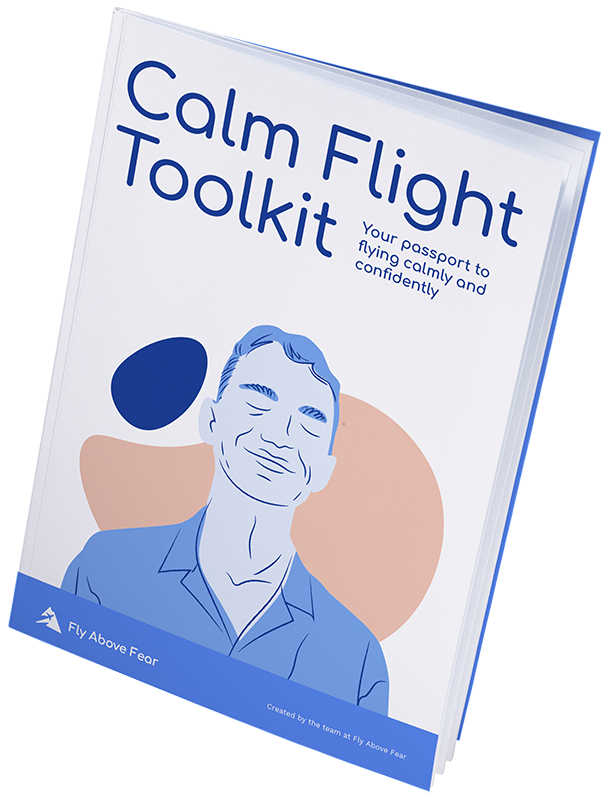
If you need more information, you can find practical tips in our Calm Flight Toolkit and on our Help Desk that can help you fly with less fear.
Does it work? Research from Stanford shows mindfulness-based interventions significantly reduce anxiety and physiological stress responses – especially in phobia patients. It’s simple, free and discrete to do, so why not give it a try?
Medication for fear of flying
We’re not qualified medical professionals and provide no advice or guidance on the use of medications for individuals.
In the UK, for example, doctors may no longer prescribe benzodiazepines or sedatives (such as diazepam) for patients experiencing fear of flying. Policies and procedures across the world differ. For accurate information, speak to a qualified and trained medical professional.
When used responsibly, under the guidance of a doctor, it can provide temporary relief, enabling individuals to function through unavoidable flights, such as for work or emergencies.
Common medications for fear of flying include:
- Benzodiazepines (e.g. diazepam, lorazepam): Fast-acting anti-anxiety medications that promote calm. They also reduce memory consolidation, which can lessen the fear response. However, they’re habit-forming and should never be taken long-term.
- Beta blockers (e.g. propranolol): These blunt the physical symptoms of anxiety – racing heart, shaking hands – by reducing adrenaline’s effects. Many people find these allow them to “ride out” a flight with fewer symptoms.
- Antihistamines (e.g. diphenhydramine): Occasionally used for their sedative properties. Less effective than true anxiolytics, but they can help in very mild cases.
It’s essential to consult with a GP or psychiatrist before taking any medication.
Some drugs can interfere with blood pressure, interact with alcohol, or impair memory and reaction time. Self-medicating is never recommended and can be dangerous.
Medication can provide brief relief, but worse outcomes in the long-term.

Hypnotherapy for fear of flying
Hypnotherapy divides opinion. While not scientifically accepted as a standalone treatment for phobias, it’s often used alongside CBT or NLP (neuro-linguistic programming) with anecdotal success.
The theory? Hypnosis places the brain in a highly suggestible but calm state. This allows the therapist to bypass the conscious mind and “rewrite” emotional responses to flying.
Some studies suggest hypnotherapy can help reduce anticipatory anxiety and lower the body’s fight-or-flight response, but findings are mixed. If it works for you, it works. Just be cautious of unregulated practitioners and exaggerated claims.
Resources like the Hypnotherapy Directory help locate qualified, registered practitioners.
Future treatments for fear of flying
Fear of flying is as old as the Wright Brothers. Technology is changing everything and could provide exciting new treatment methods for the fear of flying.
Here’s what the future may hold:
- AI-driven exposure therapy: With advances in generative environments, VR programmes may become hyper-personalised, adjusting difficulty levels based on real-time biometrics.
- Wearables + biofeedback: Devices like Apple Watch or Garmin can already track heart rate and stress. Future iterations may integrate with therapy apps to offer live interventions during flights.
- MDMA-assisted therapy: While still experimental and controversial, psychedelic-assisted therapy is being explored for PTSD and phobias. In safe, clinical settings, MDMA may help people reprocess trauma with reduced fear.
- AI companions for in-flight support: Imagine a digital therapy assistant that guides you through calming exercises in real-time during a flight. Tools like Wysa and Woebot are early versions of this, although both are limited. (Update: Since this guide was written, Woebot has removed support from its app.)
Fear of flying is not weakness
Being afraid of flying isn’t a weakness or a failure. Admitting you have a fear is a show of strength, and it’s the first step in the process to deal with it. You have already taken the first step. You’re reading this on Fly Above Fear – the world’s leading independent resource for fearful flyers who want to change.
We can’t diagnose your fear of flying or propose a treatment plan. You’ll need to follow your own path. You may find self-help, information on the science of flight, and in-flight support (like our Calm Flight Toolkit) are enough. Or you may need structured support from a professional or through a course.
For more reassurance, visit the Help Desk and download our free Calm Flight Toolkit.
Please share this article with anyone who might benefit from it.
FAQs
Fear of flying can have many causes, including a loss of control, claustrophobia and catastrophic thinking. A fear of flying can also be caused by specific triggers, like a turbulent flight or exposure to negative stories about aviation, especially following an accident or crash. Whatever the cause of your fear of flying, there is help available.
People with a fear of flying often understand it’s irrational, but it’s completely real. That’s because the brain perceives flying as dangerous and stats alone aren’t enough to combat this. Instead, you need to learn that flying is safe. That can come through a combination of experience (flying more), exposure, self help and – if needed – professional support.
There are lots of things you can do to reduce fear of flying, including learning how planes fly and develop techniques to calm anxiety. If your phobia is too strong, then cognitive behavioural therapy (CBT) has a strong evidence base to support it as a treatment for fear of flying. Virtual reality therapy, flight simulators and exposure therapy, which both use CBT principles, are also effective, as are airline-operated fear of flying courses.